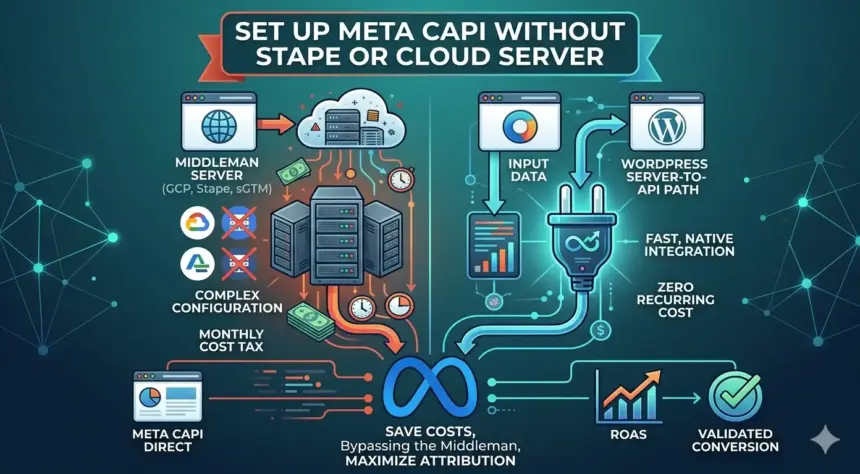
If you are running high-volume paid traffic on Meta or TikTok, implementing a server-side tracking architecture is no longer optional. With the rise of Apple’s Intelligent Tracking Prevention (ITP) and increasingly aggressive ad blockers, relying solely on a browser pixel is a guaranteed way to bleed ad spend. Without server-side data feeding the algorithm, your attribution breaks, your Conversion API (CAPI) match rates plummet, and your Return on Ad Spend (ROAS) collapses.
However, if you search for guides on how to implement Meta CAPI, almost every tutorial, agency, and YouTube video will funnel you into the exact same bloated architecture: Browser ➔ Google Tag Manager Server-Side (sGTM) ➔ Stape.io or Google Cloud ➔ Meta.
There is a massive, unspoken problem with this “industry standard” setup. It is overly complex, introduces unnecessary latency, and for high-volume media buyers, it operates as a hidden, recurring tax on your traffic.
Here is a comprehensive breakdown of the true costs of third-party tagging servers, and how to bypass them entirely using a direct integration via the ROAS Toolkit.
Table of Contents
- Executive Summary: The Direct CAPI Routing Solution
- The Hidden Costs of the “Standard” sGTM Architecture
- 1. The Financial Cost Breakdown (The Traffic Tax)
- 2. The Latency and DNS Bloat
- Demystifying Deduplication Without GTM
- Universal Funnel Scaling: Content vs. E-Commerce
- 1. Content and Traffic Arbitrage Sites
- 2. WooCommerce Product Sites
- Conclusion
Executive Summary: The Direct CAPI Routing Solution
Before diving into the financial breakdown, it is essential to understand how modern tracking bypasses the need for third-party servers entirely. The vast majority of CAPI integrations force your data through an external tagging middleman.
The ROAS Tool Kit plugin fundamentally changes this architecture by turning your existing WordPress backend into the processing server.
When a visitor lands on your site or triggers a specific engagement metric (such as a 30-second reading milestone or adding a product to a cart), the toolkit immediately generates a cryptographically secure event_id. It injects this ID into the frontend Meta Pixel script while simultaneously packaging a rich server-side payload—including the user’s IP address, user agent, and critical click identifiers like fbclid or ttclid.
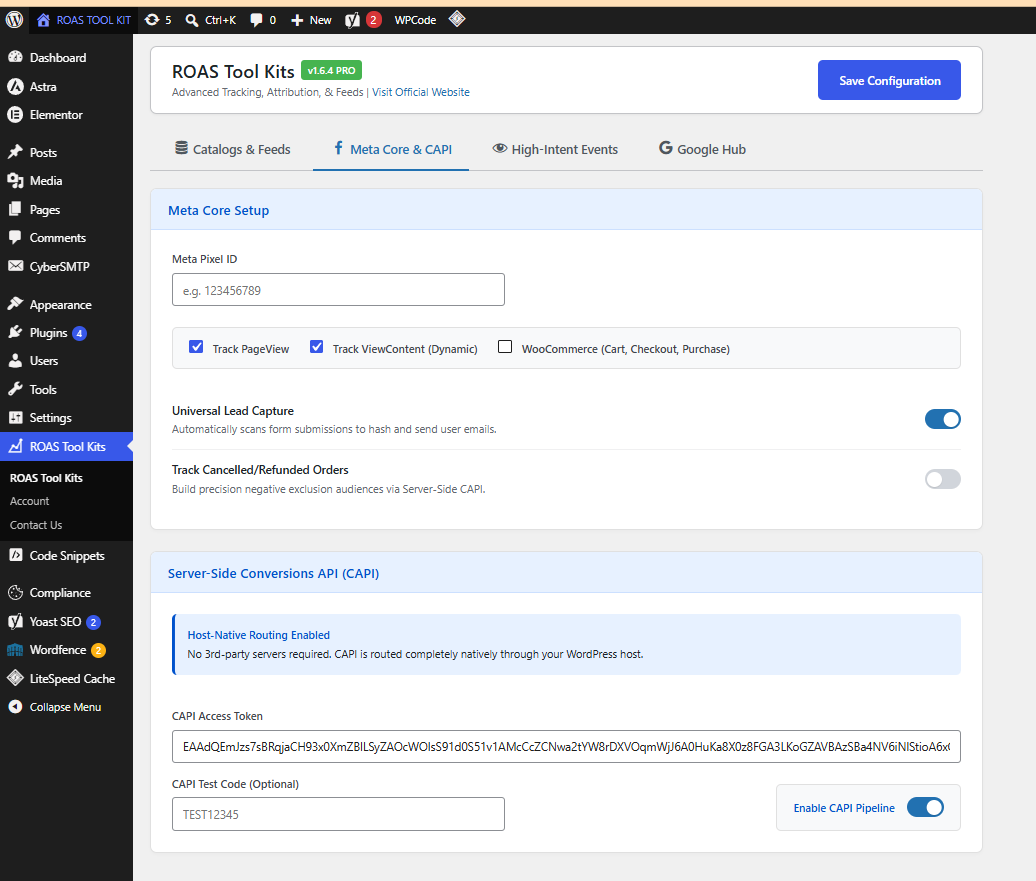
The plugin then fires this payload directly from your WordPress host to Meta’s Graph API. By bypassing the middleman server entirely, the plugin automatically handles event deduplication, eliminates external cloud hosting fees, and prevents attribution loss caused by ad blockers.
The Hidden Costs of the “Standard” sGTM Architecture
The narrative that you must use a dedicated, third-party tagging server to run Meta CAPI is heavily pushed by the software companies selling you the server space. While Server-Side Google Tag Manager (sGTM) is a powerful, centralized routing tool for enterprise corporations with complex compliance needs, it is gross overkill for performance marketers.
When you route your data through Google Cloud Platform (GCP) or managed hosting services like Stape, your operational costs scale linearly with your traffic volume.
1. The Financial Cost Breakdown (The Traffic Tax)
If you are running aggressive traffic arbitrage campaigns, multi-step advertorial funnels, or high-volume WooCommerce stores, your event volume is massive. Every single pageview, scroll depth trigger, time-on-site milestone, and outbound click is an HTTP request hitting that tagging server. Cloud providers charge based on compute resources and request volume.
- Google Cloud Platform (GCP): Running a production-ready sGTM environment on GCP requires a minimum of three servers (App Engine instances) running simultaneously to prevent data loss or timeouts during traffic spikes. For a medium-to-high volume campaign generating hundreds of thousands of events, standard GCP costs easily range from $50 to $150+ per month, per environment.
- Stape.io and Managed Hosting: While platforms like Stape offer streamlined hosting for sGTM, their pricing scales rapidly. A high-volume media buyer will burn through their entry-level tiers in a matter of days. Scaling up to tiers that can handle serious traffic volume will cost anywhere from $20 to $100+ per month.
If you are operating a portfolio of five to ten different landing page domains to test various angles and offers, these costs multiply rapidly. You can easily find yourself draining $1,000 to $3,000+ annually just to pay for a server whose only job is to pass data you already own to an ad network.
2. The Latency and DNS Bloat
Using an external tagging server adds a completely unnecessary extra hop to your data flow. Instead of your website communicating directly with Meta, your WordPress site sends the data to your Stape or GCP server, which processes the payload, and then forwards it to Meta’s Graph API.
This introduces latency. Furthermore, configuring an sGTM setup requires mapping custom tracking subdomains (e.g., tracking.yourdomain.com). This forces you to manage DNS records, provision custom SSL certificates, and wait for global propagation every time you launch a new site.
Demystifying Deduplication Without GTM
The single biggest fear marketers have when bypassing Google Tag Manager is event deduplication. They assume that if they send a “Lead” or “Purchase” event from the browser pixel, and send the exact same event from their backend server, Meta will count the conversion twice, ruining the algorithm’s data model.
Many tutorials make deduplication seem like a highly advanced technical feat that only GTM can perform. In reality, server-side deduplication is incredibly simple string matching.
To deduplicate an event, your server simply needs to generate a unique string of alphanumeric characters (the event_id) the moment the page loads. You inject that exact same string into both the frontend Pixel script and the backend API payload. When Meta’s servers receive both events within a short timeframe, they see the matching event_id. Meta keeps the richer, ad-blocker-proof server-side data, and quietly discards the browser duplicate. You do not need a $100-per-month cloud server to generate a random text string.
Universal Funnel Scaling: Content vs. E-Commerce
The beauty of a direct server-to-server integration is its universal application across different WordPress architectures. Whether your business model relies on ad-monetized media or standard e-commerce, the technical and financial advantages remain exactly the same.
1. Content and Traffic Arbitrage Sites
On content sites, advertorials, and educational hubs, your primary goal is to measure user attention.
- The sGTM Bottleneck: Content sites generate an overwhelming volume of micro-interactions (e.g., scroll depth thresholds, 30-second timers, 2-minute timers, and outbound affiliate clicks). If you route every single one of these behavioral events through Stape or Google Cloud, your server bills will skyrocket because you are charged per request.
- The Direct Fix: By handling CAPI directly on your WordPress server via the ROAS Toolkit, you can fire as many deep engagement events as you want without adding a single penny to your monthly software bill. This lets you aggressively feed Meta’s algorithm high-quality reading signals completely tax-free.
2. WooCommerce Product Sites
On e-commerce sites, your primary focus is tracking the transaction funnel accurately while protecting checkout page performance.
- Bypassing the “Cart Abandonment” Block: Many ad blockers specifically target third-party tracking scripts during the checkout process. If a user blocks the browser pixel on your checkout page, a standard setup misses the purchase entirely. A direct server-side integration guarantees that the moment a database transaction occurs on your site (Purchase), the data is pushed straight from your server to Meta, ensuring 100% accurate revenue attribution.
- Protecting Page Speed & Conversion Rates: Every millisecond matters on a product page. Loading a heavy Google Tag Manager container alongside multiple server tagging scripts slows down the mobile user experience. Dropping the middleman server and executing direct server pings frees up browser resources, keeping your product and checkout pages fast, lean, and highly optimized for conversions.
Conclusion
The reliance on expensive third-party cloud servers for Meta CAPI is a habit born out of convenience for agencies, not out of necessity for performance marketers. Every dollar spent on bloated server infrastructure is a dollar removed from your ad budget.
By moving to a direct server-to-Graph-API integration, you retain complete ownership of your data, eliminate unnecessary latency, bypass aggressive browser blockers, and completely eradicate the monthly traffic tax. Stop paying rent on your own conversion data and start protecting your ROAS.